
Humming Bird Update: How Google Understands Search Intent
The Humming Bird Update was introduced by Google in August 2013 and brought a major change to Google’s core search algorithm. Unlike smaller filter updates such as Panda and Penguin, this update improved how Google processed and understood search queries. It was designed to provide more relevant search results by understanding queries in a more conversational context. This allowed users to search using natural language and longer sentences instead of relying only on specific keywords.
Before this update, Google search relied more heavily on matching the words in a query with words found on webpages. This could make it difficult for users to find exactly what they were looking for when they used longer or conversational queries. With the Humming Bird Update, Google began focusing more on the context and meaning behind a search query. Instead of looking at individual words separately, Google could better interpret what the user was actually trying to find.
Example of the Humming Bird Update
Suppose someone searches:
“places to eat near me that are open late”
Google does not simply look for the individual keywords “places,” “eat,” “near,” and “late.” It tries to understand the overall meaning and intent of the query. In this case, the user is looking for nearby restaurants that are open late.
This shows how the this update helped Google understand the relationship between words in a search query and provide results that better matched the user’s intent.
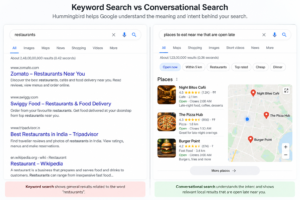
Humming Bird Update keyword search vs conversational search
Benefits of Humming Bird Update
1. Better Understanding of User Intent
The Humming Bird Update helped Google understand what users actually wanted instead of focusing only on the exact keywords used in a search. This made it easier for Google to provide results that matched the purpose behind a query.
2. Better Handling of Longer Queries
People increasingly use natural language and longer sentences while searching online. The Humming Bird Update helped Google understand these longer and more conversational queries, making search more useful for users.
3. Semantic Search
Semantic search focuses on the meaning and relationship between words rather than only matching individual keywords. The Update improved Google’s ability to understand the context and relationship between words in a search query.
4. Better Understanding of Long-Tail Keywords
Long-tail keywords are longer and more specific search phrases. As users started using more natural language in search, the update helped Google better interpret these detailed queries and connect users with relevant content.
5. More Relevant Search Results
By understanding the context and intent behind queries, this update helped Google provide search results that were more closely related to what users were actually looking for.
6. Improved Local Search Understanding
This update also improved Google’s understanding of location-based searches. For example, when a user searches for “best coffee shops near me,” Google can consider the relationship between the search terms, location, and relevant local businesses.
Impact of the Humming Bird Update on SEO
This Update changed the way website owners approached search engine optimization. Instead of creating content that simply repeated exact keywords, websites needed to focus more on useful information, natural language, context, and user intent.
For SEO professionals and website owners, this meant creating content that answers users’ questions clearly and provides genuine value. Using relevant topics, related terms, long-tail keywords, and natural language became more important than simply repeating the same keyword throughout a page.
The Humming Bird Update therefore played an important role in Google’s development toward understanding the meaning behind search queries. It helped Google move beyond simple keyword matching and toward a more context-based approach to search.